
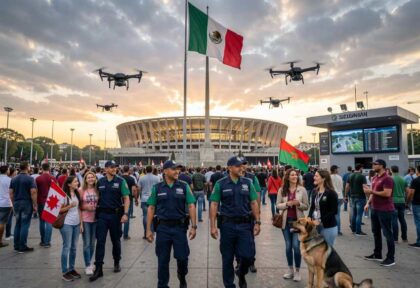
As the excitement builds around the World Cup 2026, one critical aspect takes center stage—security. Mexico, one of the proud co-hosts alongside the United States and Canada, is putting forth an unprecedented security effort to ensure the event unfolds without a hitch. The country’s plan to deploy close to 100,000 security personnel reflects both the scale of the tournament and the complexities involved in organizing a global sports event in a region recently troubled by gang violence and cartel conflicts. This extraordinary manpower includes military forces, police officers, and private security agents, coordinated to protect the 13 matches slated to take place across Mexican venues including Mexico City, Guadalajara, and Monterrey.
While the specter of instability lingers, the Mexican government has publicly committed to presenting a safe and well-managed environment, bolstered by modern technologies like anti-drone systems, aerial surveillance, and sniffer dogs. This massive operation is not just about preventing crime but also about guaranteeing public safety and effective crowd control in stadiums hosting tens of thousands of passionate fans. The strategy aligns closely with United States and Canadian security forces, underscoring the international cooperation vital to handling such a major sports event. As the tournament guns for global viewership records, Mexico’s display of robust security protocols sends a strong message that the World Cup will be as secure as it is spectacular.
Mexico’s Security Plan for World Cup 2026: An Extensive Deployment of Personnel and Technology
Hosting 13 matches, Mexico faces the dual challenge of managing international expectations and local realities, especially in states affected by cartel violence such as Jalisco, home to Guadalajara. The death of cartel leader Nemesio “El Mencho” Oseguera has escalated tensions in the region, which demands heightened readiness. The government’s response is a deployment of roughly 20,000 military personnel, including National Guard members, complemented by about 55,000 police officers and additional private security staff. This vast security network is enhanced by nearly 2,500 vehicles, 24 aircraft, advanced drone-detection systems, and canine units specialized in drug and explosive detection.
Commanded by General Román Villalvazo Barrios, this coordination hub ensures that both law enforcement and stadium security work seamlessly to anticipate and neutralize threats. The involvement of technology-driven solutions also represents an important innovation, designed to protect players, officials, and especially the fans whose energy and safety are crucial to the event’s success. With the opening match scheduled at the iconic Azteca Stadium in Mexico City, the stakes are undeniably high.

International Collaboration and Security Assurance
The tri-nation hosting arrangement brings together three distinct law enforcement cultures. Mexican officials have engaged in ongoing intelligence sharing and tactical planning with counterparts in the United States and Canada. A high-level meeting led by Mexico’s Secretary of Security, Omar Garcia Harfuch, with FIFA representatives reinforced this unity, reviewing prevention, operational deployment, and intelligence protocols that will be rigorously applied throughout the tournament.
Despite Mexico’s recent challenges, president Claudia Sheinbaum’s assurances that security measures leave “no risk” for supporters underline the seriousness of the preparations. FIFA president Gianni Infantino echoed confidence, visibly reassured by Mexico’s continued cooperation. This reassured atmosphere benefits not only the delivery of a seamless tournament but also the international profile of Mexico as a capable host for a mega-sports event.
How Mexico’s Security Strategy Impacts Fans and Betting on World Cup 2026 Matches
From a fan’s perspective, the comprehensive security framework guarantees a more relaxed experience around the stadiums and fan zones. However, for those of us eager to engage with the tournament on a deeper level, especially through intelligent betting, understanding these security dynamics can be crucial. A tense atmosphere influenced by security threats in certain cities might affect team performances or crowd behavior.
Guadalajara and Monterrey, set to host both group stage matches and critical playoffs, are hotspots where vigilance will be highest. Observers should keep an eye on any information about security alerts or crowd restrictions when deciding bets. It’s also worth noting how fan attendance and team morale might respond to these conditions. For thorough tips on the tournament, including game schedules, venues, and betting strategies, check resources such as the World Cup 2026 French schedule and the official ticket platforms.
| 🏟️ Host City | ⚽ Number of Matches | 👮♂️ Security Personnel Deployed | ✈️ Support Equipment |
|---|---|---|---|
| Mexico City | 6 | 40,000 (Military + Police + Private) | 15 Aircraft, Anti-drone Systems, Sniffer Dogs |
| Guadalajara | 4 | 35,000 (Including National Guard) | 5 Aircraft, 1000+ Vehicles, Drone Detection |
| Monterrey | 3 | 24,000 (Military and Police) | 4 Aircraft, Enhanced Surveillance Tech |