
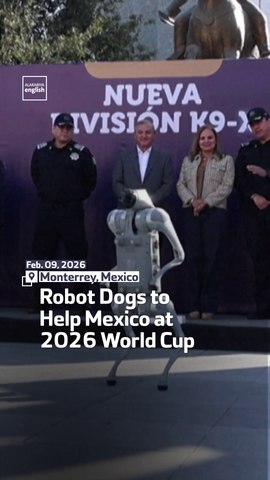
The 2026 FIFA World Cup, a global spectacle of football, is already making headlines far beyond the pitch. As Mexico prepares to host thirteen matches in this massive tournament shared with the United States and Canada, authorities in Guadalupe have unveiled an innovative security measure: robotic dogs deployed to assist Mexican police forces. This leap in technology represents a bold step in public safety and crowd control, integrating advanced robotics into high-stakes event surveillance. Charged with scouting potentially dangerous areas before human intervention, these robotic units symbolize a proactive approach to law enforcement, setting a new standard in tournament security amidst an event that brings together thousands of passionate fans.
Behind the scenes, these four canine robots, acquired at a cost of approximately 120,000 euros, will operate mainly during incidents of unrest, protecting the physical integrity of officers by serving as first responders. This cutting-edge strategy reflects the tournament’s broader fusion of sport and technology, while also highlighting Mexico’s significant role as the first nation to host the Men’s World Cup three times. Despite hosting fewer matches than the United States, Mexico is far from a mere spectator, underscoring its historical weight in global football events. This unique blend of security technology and football culture aims to ensure a safe, electrifying atmosphere for all attendees and supporters, including us backing the French team.
Robotic Dogs: A Novel Security Asset for Mexican Police at the FIFA World Cup
The deployment of robotic dogs by the Mexican police in Guadalupe marks a pioneering moment in the security preparations for the upcoming FIFA World Cup. Designed primarily for surveillance and crowd control, these quadruped machines—likely Unitree Go2 models—will patrol the vicinity of the BBVA Stadium. Their primary duty lies in venturing into risky or densely packed zones, providing real-time video surveillance and issuing voice commands to manage or defuse tense situations.
Rather than replacing human law enforcement officers, these robotic dogs exhibit a complementary role, enhancing officer safety by acting as advance scouts. This technology allows rapid assessment of threats and reduces human exposure to potential harm during critical incidents. The Guadalupe city council’s investment signals a growing recognition of robotics as indispensable tools for public safety in major sporting events.
Technology and Surveillance Shaping Crowd Control Strategies
Security challenges at a tournament as colossal as the FIFA World Cup demand innovation. With an expected influx of passionate and often unpredictable fans, combining conventional methods with advanced technology is crucial. The robotic dogs are equipped to navigate complex environments, stream live footage to command centers, and facilitate swift decision-making for human officers.
Additionally, these devices are unarmed; their mandate is to scout and surveil, not to engage physically. Such nuanced deployment hopefully diminishes the potential for excessive force and keeps the atmosphere conducive to celebration rather than confrontation. For those of us following the matches closely, understanding these behind-the-scenes security layers adds a new dimension to appreciating the event’s scale and complexity.
Mexico’s Role in Hosting the FIFA World Cup: Between History and Modern Challenges
While Mexico hosts only thirteen of the 104 total matches, sharing duties with the United States and Canada, its contribution to the World Cup legacy remains immense. Having previously hosted the tournament twice (1970 and 1986), Mexico stands alone as the only country to host three FIFA Men’s World Cups. This positions the nation prominently despite a numerical imbalance in game allotment compared to the U.S.
This disparity can appear reductive on the surface, almost relegating Mexico to a secondary role. However, the country’s persistent dedication to football and its fans ensures that these matches in Monterrey will be fiercely contested and deeply celebrated. For the French team and their supporters, this serves as a reminder not to underestimate the passion and pride these venues will carry during heated group and knockout stages.
| Host Country 🏟️ | Number of Matches ⚽ | Historical Hosting Count 🌍 |
|---|---|---|
| United States 🇺🇸 | 78 | 1 (1994) |
| Mexico 🇲🇽 | 13 | 3 (1970, 1986, 2026) |
| Canada 🇨🇦 | 13 | 1 (2026) |
Security, Surveillance, and Robotics: What It Means for Fans and Bettors
With security tightened through such innovative methods, fans can expect a safer environment to enjoy the games, but also a more regulated atmosphere. As enthusiasts backing Team France, it’s worth noting how these technological advances reflect on the overall organization and smooth running of the event. Betting on matches, for instance, benefits indirectly from this stability; fewer security disruptions mean the flow of the tournament remains intact, giving us clearer insights into team performances and strategies.
Moreover, understanding how policing adapts to crowd behavior and emergencies reveals much about how teams manage pressure on the field. The robust surveillance and proactive law enforcement ensure distractions remain minimal. Parier intelligemment becomes possible en analysant non seulement les qualités sportives mais aussi le contexte organisationnel et sécuritaire qui encadre chaque match.